
Heat Pump
Heat pumps run on electricity, though the heat it utilises is renewable. A high coefficient of performance or COP is one of the most prominent advantages of air source heat pumps.
It accounts for 300-400%, meaning that for one unit of power it consumes, it generates up to 4 units of renewable energy.
Heat pumps function much like an ordinary refrigerator in your kitchen that gets heat from the inside.
An air source heat pump acts in a reversed way – it extracts heat from the outside ambient air and uses it for indoor heating.
The external unit looks similar to the air conditioner.
Ground source heat pump
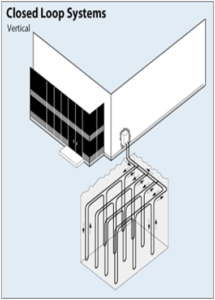
A ground source heat pump can be used to extract heat energy from the ground in winter and to transfer the heat into buildings. Equally it can be used to provide a very efficient mechanism for heat to escape from buildings down into the ground in summer.
Ground source heat pumps are suitable for a wide variety of buildings and are particularly appropriate for low environmental impact projects.
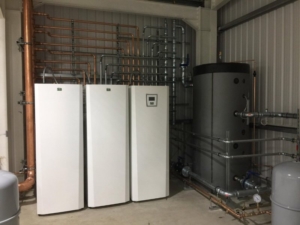
They can be installed anywhere in the UK, using a borehole or shallow trenches or, less commonly, by extracting heat from a pond, a lake or the sea. Heat collecting pipes in a closed loop, containing water (with a little antifreeze) are used to extract this stored energy, which can then be used to provide space heating and domestic hot water.
Heat pumps can also be reversed in summer to provide cooling.
Ground source heat pumps are cheaper to run than oil boilers and can be cheaper than running gas boilers.
Ground source heat pumps are very well suited to commercial buildings, especially those which have a need for cooling in summer as well as heating in winter.